
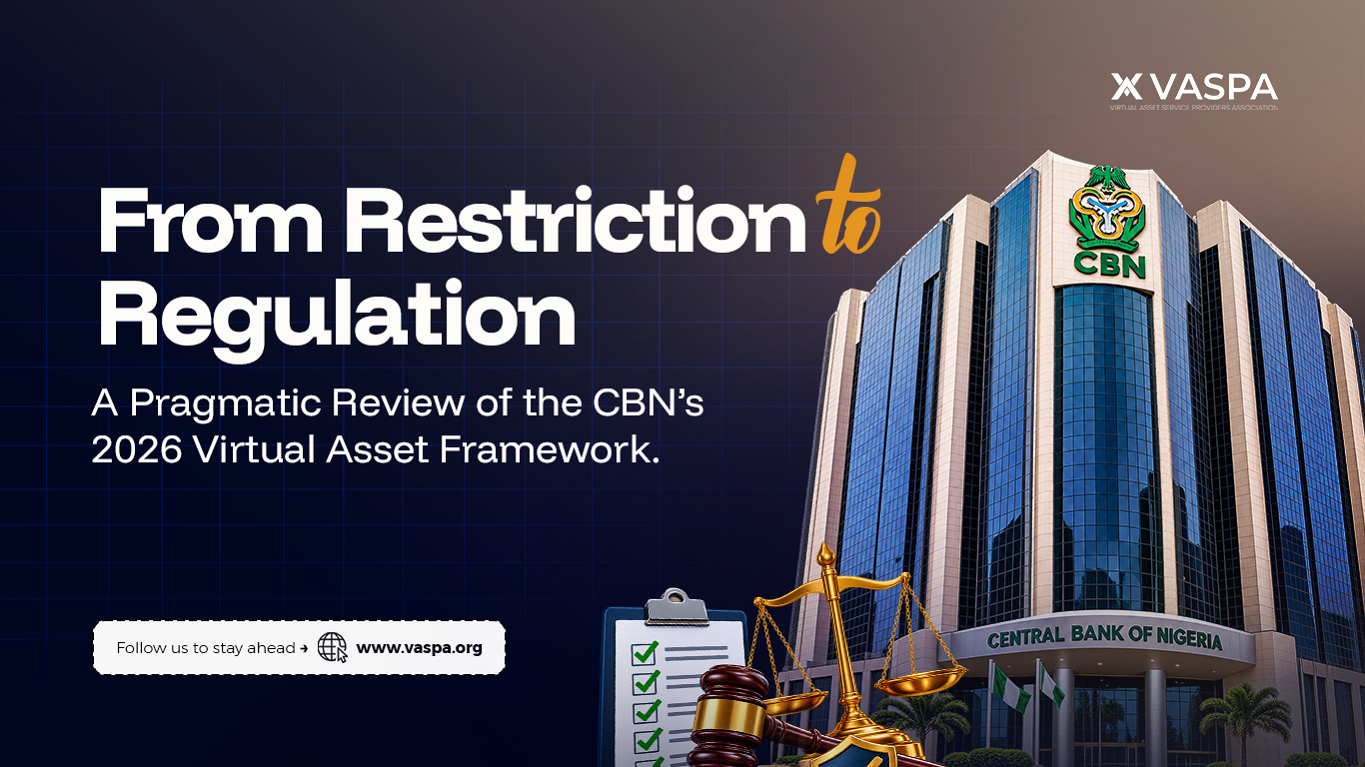
The Central Bank of Nigeria’s 2026 “Regulations for the Operations of Non-Security Virtual Assets in Nigeria” represents a significant milestone for the nation’s digital economy. For years, the industry championed the premise that structured governance, not prohibition, is the only sustainable path to national security and economic growth. The CBN has actively listened, delivering a framework that establishes a formidable foundation for the future of finance in Nigeria. The Virtual Asset Service Providers Association (VASPA) welcomes this positive development.
To conduct a fair and pragmatic review, we must recognize the structural triumphs of this framework before addressing the areas where the regulations risk stifling the very innovation they seek to protect.
I. The Commendable Milestones: Where the CBN Got It Right
The 2026 Regulations introduce several commendable provisions that prioritize institutional transparency and systemic stability.
- Unprecedented Institutional Delineation (CBN vs. SEC): Historically, regulatory overlap has been a massive hurdle. The CBN has solved this by codifying a strict, functionally driven delineation matrix in Section 4 and Schedule 8. By explicitly stating that the CBN regulates the payment and settlement legs while the SEC retains authority over the securities and capital markets venues, the framework eliminates jurisdictional ambiguity.
- Consumer Protection and Bankruptcy Remoteness: The framework sets a gold standard for holder protection. By mandating that reserve assets be held under an express Declaration of Trust and supported by an independent Nigerian legal opinion, the CBN ensures that reserves are completely bankruptcy-remote. In the event of an issuer’s insolvency, token holders hold a first-priority claim, and the CBN is empowered to appoint a Special Purpose Administrator to oversee orderly redemptions.
- Pioneering Deposit Money Tokens (DMTs): Part 10 of the regulations authorizes licensed Deposit Money Banks (DMBs) to issue Deposit Money Tokens (DMTs) that rank pari passu with conventional deposits and retain NDIC insurance eligibility. This provides institutional players a safe, highly regulated entry point into tokenization.
- Pragmatic Transition Windows: Section 54 provides a 180-calendar-day transition window for existing operators to align their operations and apply for the necessary licenses, provided they immediately enforce AML/CFT controls and commence reporting.
II. Critical Analysis: Where the 2026 Framework Misses the Mark
While the foundational architecture is strong, regulatory frameworks in emerging sectors must be calibrated to transit from grassroot adoption to institutional adoption by adopting a developmental regulation approach rather than inadvertently cementing oligopolies.
1. Capital Exclusivity: The Death of the Web3 Startup
The CBN requires a flat minimum paid-up capital of ₦10 billion for Class 1 (Naira) issuers and ₦15 billion for Class 2 (Foreign Currency) issuers. A non-issuing startup applying for an Other Services Licence (OSL) must lock down ₦1 billion in cash or FGN securities.
Favour Uche, Policy & Regulatory Affairs Lead at VASPA and Project Manager of Project Green-White-Green, highlights the long-term impact of this approach:
“The introduction of Deposit Money Tokens (DMTs) and the strict anti-commingling rules are major policy victories that align Nigeria with global best practices like MiCA. However, looking at this through the lens of developmental regulation, the framework misses a critical opportunity to nurture early-stage innovation. By demanding massive capital lockups and sterile reserve deposits rather than proportional, risk-weighted compliance, the regulations heavily favor legacy financial institutions. If we want Project Green-White-Green’s vision of a harmonized, inclusive digital economy to succeed, we urgently need the CBN to introduce a ‘Restricted’ or ‘Micro’ VASP license category to keep local startups in the regulated fold.”
2. Reserve Inefficiencies: The 20% Sterile Cash Trap
Section 24.25 mandates that Class 1 issuers hold a minimum of 20% of their total Reserve Pool as a non-interest-bearing cash deposit at the CBN. In our current macroeconomic reality, parking 20% of a stablecoin’s backing in sterile, non-yielding fiat effectively guarantees the reserve’s purchasing power will erode. Since stablecoin issuers are explicitly banned from paying yield to users, starving the issuer of yield on a fifth of its reserves severely degrades the commercial viability of a Naira stablecoin.
3. FX Rigidity in P2P and Remittances
Under Section 11.10.5, cross-border stablecoin payments for imports require a legacy “Form M,” while export proceeds received in crypto demand a “Form NXP” and must be routed through traditional Authorized Dealers. P2P conversions between Naira and Class 2 stablecoins are similarly bottlenecked through legacy rails.
Franklin Peters, CEO of BoundlessPay and Executive Chair of VASPA, speaks to the operational friction this creates for the industry:
“From an industry operator’s standpoint, having a recognized regulatory perimeter is a massive relief, and the 180-day transition window shows the CBN’s willingness to integrate existing players safely. But the operational mechanics mandated for cross-border and P2P transactions are deeply concerning. Forcing borderless, programmable stablecoin settlements through legacy Authorized Dealer pipelines using Form M and Form NXP fundamentally defeats the speed and cost-efficiency of blockchain technology. Furthermore, the sheer capitalization required to hold an Other Services Licence (OSL) will squeeze out local competition. We need the CBN to adopt API-driven FX reporting and realistic capital tiers; otherwise, we risk driving trading volumes out of licensed platforms and back into the shadow economy.”
4. Strict Localization vs. Borderless Realities
The framework demands that any foreign-currency stablecoin (Class 2) made available to Nigerians must be issued by a locally incorporated Nigerian entity. A mandate forcing global, decentralized issuers to incorporate locally, deposit ₦15 billion, and run separate Nigerian operational liquidity buffers threatens to isolate Nigeria from deep international liquidity pools.
Altogether, capturing the gravity of this shift, Senator Ihenyen, Lead Partner at Infusion Lawyers and Founding Trustee of VASPA, notes:
“I am particularly delighted with the CBN’s decision to finally address VASPs directly rather than by proxy. The 2026 CBN Regulations represent a significant moment for Nigeria’s digital asset economy. For years, we advocated that structured governance is the only sustainable path forward. By codifying bankruptcy-remoteness for reserves and providing jurisdictional boundaries between the CBN and the SEC, the apex bank has laid a crucial foundation. However, we must be careful not to stifle innovation at a time the industry is yet to attain institutional adoption. Imposing a flat ₦10 billion capital requirement for issuers and a ₦1 billion floor for basic service providers, without a tiered licensing framework, risks replacing a shadow ban with an economic one, after replacing the blanket ban of 2021 with what one might call a shadow ban in 2024. To truly lead the future of finance, our regulations need to consider approaches that protect consumers and ensure financial stability without necessarily stifling the massive grassroot adoption that drives genuine innovation in the country.”
III. Comparative Jurisdictional Analysis: Global Best Practices
When observing jurisdictions successfully capturing digital economy value, the common denominator is risk-based proportionality.
- European Union (MiCA): MiCA categorizes tokens pragmatically (Asset-Referenced Tokens vs. E-Money Tokens). While the CBN demands ₦10 Billion to issue a Naira stablecoin, MiCA requires Asset-Referenced Token (ART) issuers to hold €350,000 or 2% of reserve assets—scaling up to 3% only if the token becomes systemically “significant.” MiCA does not force issuers to park 20% of their reserves in sterile accounts at the central bank.
- Dubai (VARA): VARA utilizes an agile, activity-based licensing model dividing services into specific operational categories. VARA offers a Minimum Viable Product (MVP) testing phase with progressive capital requirements, directly contrasting with the CBN’s monolithic, high-barrier OSL requirement.
- South Africa (FSCA/SARB): South Africa pragmatically declared crypto assets as financial products under their existing Financial Advisory and Intermediary Services (FAIS) Act. VASPs operate as standard Financial Services Providers (FSPs) with capital adequacy tied to actual operational risk, fostering a highly compliant but accessible market.
- United Kingdom (FCA/BoE): The UK regulates fiat-backed stablecoins under modernized e-money frameworks, prioritizing highly liquid commercial safeguarding that allows issuers to earn yield on High-Quality Liquid Assets (HQLA) to sustain compliance operations, rather than locking massive percentages of reserves at the Bank of England.
IV. Strategic Recommendations for the CBN
To ensure Nigeria retains its global competitiveness in digital finance and builds on the baseline established by these regulations, we must refine the framework from a posture of strict defense to one of strategic enablement.
1. Implement Tiered and Modular Licensing
The CBN should amend Section 16 to replace the flat ₦1 billion OSL requirement with a tiered, risk-weighted model. A custody provider holding billions in client funds should face strict capital floors. However, a non-custodial matching engine should operate under a “Restricted” or “Micro” VASP license with a capital floor closer to ₦50 million, scaling progressively as transaction volume grows.
2. Optimize Reserve Economics for Class 1 Issuers
To ensure Naira stablecoins are commercially sustainable, the CBN must amend Section 24.26 to convert the mandatory 20% non-interest-bearing cash deposit into a requirement to hold short-term sovereign debt (e.g., 90-day FGN Bills) held in a segregated CBN account. This maintains systemic safety and central bank visibility while allowing the issuer to earn a baseline yield to fund its mandatory and capital-intensive AML/CFT compliance and operations.
3. Establish a Wholesale Equivalence (Passporting) Regime for Class 2 Stablecoins
Instead of demanding full local incorporation and a dedicated ₦15 billion capital base for every foreign stablecoin (Section 11.1), the CBN should expand its wholesale recognition powers (Section 11.10.17). If a stablecoin is regulated by a Tier-1 global authority, it should be permitted to operate in Nigeria via local licensed OSL distributors, provided the distributor maintains the required local operational liquidity buffer.
4. Modernize Digital FX Integration via APIs
The CBN must decouple stablecoin remittance reporting from legacy trade finance architecture. Rather than forcing fast on-chain transactions through slow Authorized Dealer pipelines with Form M/NXP, the CBN should deploy an automated Digital FX API. Licensed OSLs would report cross-border token flows in real-time directly to the CBN balance-of-payments ledger.
V. Conclusion
The transition from a restrictive stance to the comprehensive 2026 Regulations is a victory for Nigeria’s financial ecosystem. By making these pragmatic, risk-weighted adjustments, the CBN can ensure that our regulatory framework not only protects consumers but actively cultivates the next generation of African digital innovation. Nigeria must move from defence to enablement. At this initial stage, this is what the country needs to transition from grassroot growth to institutional maturity.
VASPA Virtual Townhall
Theme: Decoding the 2026 CBN Virtual Asset Regulations: Balancing Systemic Stability with Grassroots Innovation
Date: Saturday, November 21, 2026
Time: 2:00 PM – 4:00 PM (WAT)
Platform: @VASPAAfrica X Spaces
Purpose: To aggregate and articulate stakeholder opinions for submission to the CBN.
Venue: @VASPAAfrica X Spaces
Watch this space!
About Us
The Virtual Asset Service Providers Association (VASPA) is a Pan-African industry body registered as an Incorporated Trustee with the Corporate Affairs Commission in Nigeria (CAC IT: 79069970) where it is headquartered. VASPA comprises individual, corporate, and institutional members from across Africa. For more information about us, please visit our website, www.vaspa.org. To become a Patron or Partner of VASPA, visit our Membership page: https://vaspa.org/join-us/. Individual and corporate members are also welcomed.